




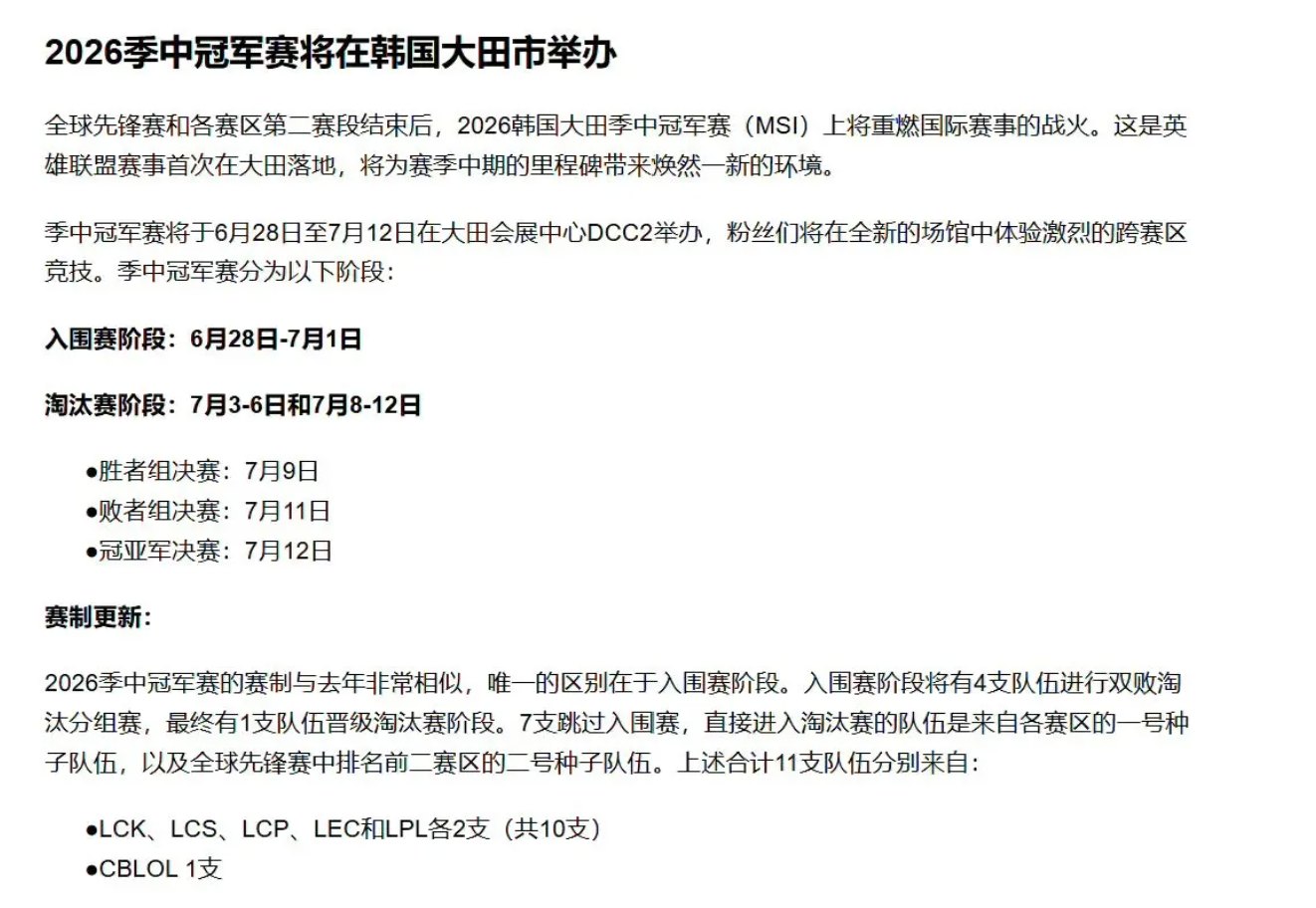
On the evening of March 22nd, Riot Games officially announced detailed information about the 2026 Mid-Season Invitational (MSI) World Championship for League of Legends. As one of the most important international tournaments of the year, the MSI brings together top teams from all regions around the world to compete for the honor of being the strongest team of the year. The news immediately caused a stir in the Chinese esports community.
Major esports media outlets—including the official League of Legends website, 17173, and Wanplus Esports—have published in-depth analyses: some analyze the choice of event dates and venues, others discuss the participating teams and qualification prospects in each region, and still others predict the probability of LPL teams winning the championship. Discussions continue to heat up on player communities such as Tieba, NGA, and Score.
International students want to access information but can't get in.
However, for international students studying abroad, this excitement is somewhat "unattainable." One esports enthusiast studying in Europe shared: "I wanted to see the official Riot Games tournament announcements, but the League of Legends website wouldn't load." "The NGA tournament discussion forum clearly has in-depth analysis, but when I click on it, it just keeps spinning and doesn't load any content for ages."
Even more frustratingly, some users who managed to open the page found that interactive functions were limited—they couldn't post comments, likes didn't work, and even saved articles couldn't be synced. This "half-crippled" experience led many to simply give up on following the event's updates.
Why is access to domestic esports platforms restricted for overseas users?
The problem stems from two aspects: network architecture and compliance policies. Domestic esports platforms and communities primarily deploy their servers within mainland China. Overseas users accessing these platforms need to traverse international bandwidth, making latency and packet loss almost unavoidable. Furthermore, for compliance reasons, platforms restrict certain functions for overseas IP addresses, such as commenting, liking, and saving.

The solution is straightforward—make the platform think you're accessing the site from within China. Game accelerators like QuickFox do exactly that: they create an encrypted tunnel back to China, with all traffic exiting through domestic nodes. This reduces latency and avoids functional limitations caused by abnormal IP addresses.
What can you gain after speeding up?
The use cases are actually quite diverse: you can check the League of Legends official website in real time to follow the latest tournament announcements, participate in in-depth discussions in the NGA player community, and even exchange views and predict match results with domestic players on Tieba. The improved experience after acceleration is intuitive—pages load instantly, articles can be read, and comments can be posted.
Kind tips: QuickFox is currently offering a limited-time promotion: free acceleration for three games—Delta Force, Valorant, and Naruto—until March 31st! While esports information is not included in the free trial, new users can register and use the redemption code 【QF51】 to receive 12 hours of free trial time, which can be used to test the acceleration effect.
Click the link below to download QuickFox, register, and use the redemption code 【QF51】 to receive a free 12-hour trial membership. Esports enthusiasts who want to stay up-to-date on all the latest Mid-Season Cup news will find this timeframe sufficient for in-depth coverage of the tournament!